Pages

Thursday, April 13, 2023

An Auctioneer Has Confessed to Playing a Major Role in Producing Fake Basquiats Displayed at the Orlando Museum of Art Los Angeles auctioneer Michael Barzman pled guilty to lying to the FBI about creating the works.

Sarah Cascone, April 12, 2023
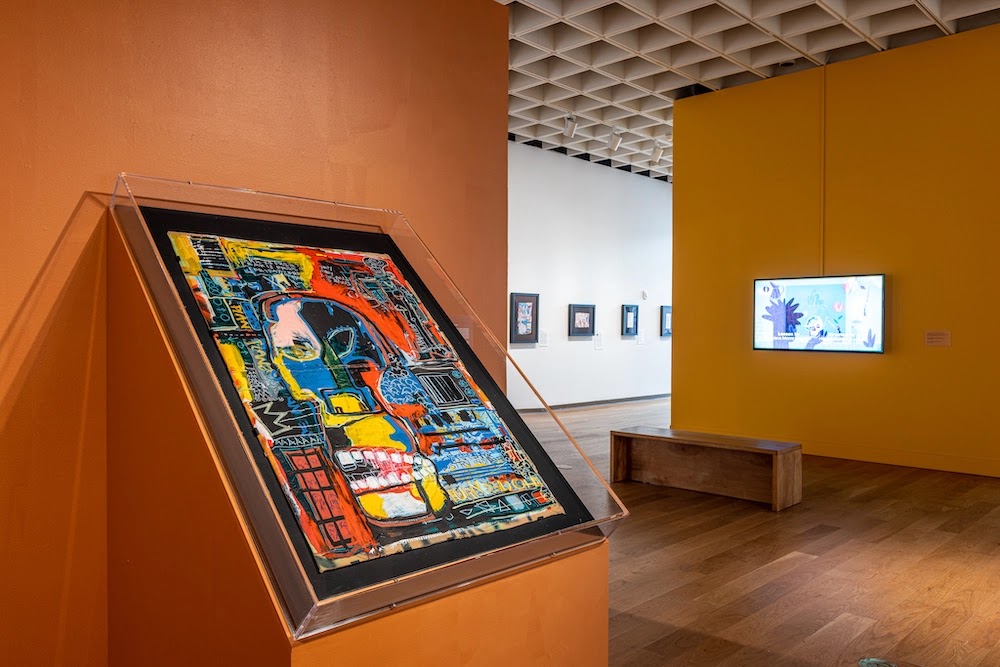
Installation view of the "Heroes & Monsters: Jean-Michel Basquiat, The Thaddeus Mumford, Jr. Venice Collection" at the Orlando Museum of Art, 2022. Courtesy of the OMA.

The exhibition had one of those fairytale backstories: the Orlando Museum of Art had lucked into a storage unit full of previously unseen paintings by Jean-Michel Basquiat, which it was showing to the public for the first time. Now, more than nine months after a dramatic FBI raid shuttered the exhibition “Heroes & Monsters,” which ran from February to June 2022, the truth is out. The paintings were not the work of the late street artist—whose work has sold for over $100 million at auction—but a series of forgeries by 45-year-old Los Angeles auctioneer Michael Barzman and an accomplice identified only as J.F.

On April 11, the United States attorney’s office for the Central District of California charged Barzman with making false statements to the FBI. He had previously denied both having painted the works or having had someone make them for him when speaking to the FBI in 2022. He has pled guilty to the charge, and faces up to five years in jail. “J.F. spent a maximum of 30 minutes on each image and as little as five minutes on others, and then gave them to [Barzman] to sell on eBay,” the plea agreement said, according to a statement from the attorney’s office. “[Barzman] and J.F. agreed to split the money that they made from selling the fraudulent paintings.”

The two are said to have created 20 to 30 fake works around 2012 that they attributed to the artist. Barzman, whose business was auctioning off the contents of abandoned storage units, concocted a fake provenance for the works: Basquiat was said to have sold the cardboard paintings to television screenwriter Thad Mumford for $5,000 in 1982. Decades later, Mumford was behind in rent payments on his storage unit, and its contents went up for auction. It was a compelling story, and it was one that inspired storage hunter William Force and his financial backer, Lee Mangin, to purchase the lot for $15,000. After a messy lawsuit surrounding one of its opinions, the Basquiat estate had shut down its authentication committee in 2012, making it difficult for Force and Magnin to get anyone to officially weigh in on the question of authenticity.

But the fake works nonetheless found champions in some art experts, including Basquiat scholar Jordana Moore Saggese and curator Diego Cortez, founding member of the Basquiat estate’s authentication committee who died in 2021. Both agreed the works looked legitimate (according to her affidavit, Moore Saggese in said she was paid $60,000 by the Basquiat artworks’ owners in 2017 to assess the paintings). Handwriting expert James Blanco also found that the works’ signatures were a match to that of the artist. Due to these factors, it seems that the Orlando Museum leadership was confident that everything was legitimate and the museum published an exhibition catalogue with new essays on the 25 works, and touting a 500 percent uptick in attendance driven by the show. Nevertheless, suspicion about the works arose quickly after the show opened in Orlando in February 2022. The main red flag was a FedEx logo on one of the pieces of cardboard—the company hadn’t introduced it until 1994, six years after Basquiat’s death. (The FBI’s Art Crime Team later confronted Barzman about one of the works, pointing out that one of the works had been painting over a mailing label with his name.)

The raid didn’t happen until June, less than a week before the show was set to close—but the FBI had been investigating the case for years.
Installation view of the "Heroes & Monsters: Jean-Michel Basquiat, The Thaddeus Mumford, Jr. Venice Collection" at the Orlando Museum of Art, 2022. Courtesy of the OMA.

Mumford, it turned out, had told an FBI agent back in 2014 that he had never purchased any Basquiats or kept any in his storage unit. He even signed an FBI affidavit the year before he died in 2018, admitting that “at no time in the 1980s or at any other time did I meet with Jean-Michel Basquiat, and at no time did I acquire or purchase any paintings by him.” Following the FBI’s seizure of the suspect works, the museum fired Aaron De Groft as its director and chief executive. He has not been charged with any wrongdoing. The beleaguered institution has formed a “task force” to help rebuild the public’s trust following the fiasco.

An archived version of Barzman’s auction website stated that he “specialize[d] in storage auctions, abandoned property, buying gold and silver, collectibles, Hollywood memorabilia, classic cars, vintage instruments and more,” noting that “since 2015, Michael has been a bonded auctioneer & appraiser of rare memorabilia and collectibles.”

The FBI investigation into the case is still ongoing.

https://news.artnet.com/art-world/auctioneer-orlando-museum-art-basquiat-2283954

Wednesday, January 11, 2023

Man Accused of Selling Faked Warhols Arrested After Wife Goes Missing

BY SHANTI ESCALANTE-DE MATTEI
January 10, 2023 2:16pm
One of the paintings Walshe sold to Revolver Gallery.

Brian Walshe, a Massachusetts man who was arrested after his wife went missing, is the subject of renewed scrutiny after the investigation into him brought back to light his alleged sales of fake Andy Warhol paintings.

In 2016, Walshe, with some assistance from his wife Ann, listed two paintings that they claimed were made by Warhol as a part of his 1979 “Shadows” series on eBay for a combined price of $100,000. According to the original complaint, written that same year by FBI special agent Kristin D. Koch, the item description of the paintings claimed that Walshe had “terribly overpaid” for the pair of paintings in a 2007 Christie’s auction for $240,000. He was offering them for $100,000 on eBay, he explained, because “it is much cheaper and because Christie’s won’t be able to auction our pieces till May 2017.”

Due to some dire financial need, Walshe was willing to offer the pieces for much less than they were worth. Walshe also wrote that the pieces were numbered and registered with the Warhol Foundation, and that they had additional provenance documents from Christie’s.

Two employees from Los Angeles’s Revolver Gallery flew to Boston, where Walshe resides, to pick up and pay for the two paintings, which they bought for a total of $80,000. One representative of the gallery waited in the car while an assistant went into the Four Seasons hotel to retrieve the paintings and hand over a cashiers check made out to Walshe’s business account.

The assistant couldn’t see the authentication stamps from the Warhol Foundation because a frame was covering the backs of the paintings. She sent a photo of the paintings to her boss, who was waiting in the car, and he approved the transaction. However, after the Revolver Gallery employees compared the pictures they had originally seen of the paintings on eBay to the works they had in their hands, they saw significant differences and demanded a refund.

In the coming months, Walshe would allegedly delay, and according to the complaint, he ended up sending only $30,000 of the $80,000 he owed Revolver Gallery. After some time, Revolver Gallery got the FBI involved.

Upon an investigation, the FBI found that Walshe was, in fact, in possession of two possibly authentic Warhol paintings that he had stolen from a South Korean friend he had made in the one year he attended Carnegie Mellon.

The FBI said that Walshe had offered to sell numerous works his friend held, including a porcelain statue from the Tang Dynasty, two Keith Haring Prints, and the two Warhol paintings in question. But after Walshe took them, his friend was never able to get back the two Warhols that Walshe had taken from him.

When Walshe posted the paintings for sale on eBay, he had allegedly taken pictures of these stolen paintings to land the deal with Revolver Gallery, but passed off two faked paintings to Revolver Gallery when it came time to sell. Although Walshe faces counts of wire fraud and other crimes, he has not yet been charged, in part because there is another case open against him that concerns whether he stole from his late father’s estate after destroying his father’s will, according to the New York Post.

Walshe’s wife, Ana, was declared missing by her company on January 4. Walshe was arrested and appeared in court on Monday after investigators found that he had violated the terms of his probation, reported Fox News.

Investigators found blood in the family basement and a damaged knife. They also found that Walshe went to Home Depot, a violation of his house probation, to purchase $450 worth of cleaning supplies and had Googled “how to dispose of a 115-pound woman’s body.” The Walshes have three young sons.

https://www.artnews.com/art-news/news/man-faked-warhols-arrested-after-wife-goes-missing-brian-walshe-1234653123/

Friday, January 6, 2023

Italian Police Confiscated a $4.2 Million Rubens Painting From a Genoa Exhibition as Part of a Fraud Investigation

A decade ago, the owners illegally exported the piece and staged fake sales abroad to boost its value, according to the Carabinieri.
Peter Paul Rubens, The resurrected Christ appears to his mother (c. 1612-16). Courtesy of the Carabinieri Tutela Patrimonio Culturale. Last week, Italian police pulled a Peter Paul Rubens painting from a Genoa exhibition, citing an investigation into the artwork’s two owners, who have been accused of money laundering and illegal exportation.

Now, according to the Art Newspaper, the 17th-century canvas has been returned to the show, called “Rubens in Genoa.” However, the probe into the owners continues, as law enforcement officials look into how they allegedly smuggled the painting out of the country a decade ago in an elaborate plot to boost its market value.

At the heart of the case is The resurrected Christ appears to his mother (c. 1612-16), a six-foot-tall painting, attributed to Rubens and his workshop, that depicts the Madonna kneeling before Christ in a cobalt blue cloak. On view now alongside 18 other Rubens works in Genoa’s Doge’s Palace, it is insured for €4 million ($4.2 million).

The artwork’s current owners acquired the artwork from the noble Cambiaso family for €300,000 in 2012, according to the Carabinieri agency for the protection of cultural heritage in Genoa.

However, just two years later, in 2014, the purchasers, along with an accountant and his son, exported the piece to Prague by claiming it was created by an unknown Flemish artist and was worth only €25,000.

They are believed to have obtained an export certificate from an accomplice who worked at the superintendent export office in Pisa. That same office was temporarily shut down in 2019 due to “irregularities” in the issuance of other certificates, the Italian newspaper Corriere della Sera reported.

The four suspects then established companies abroad to stage fake sales of the Rubens painting in an attempt to bolster its worth.

In 2015, conservators controversially removed a layer of the painting’s surface to uncover a second woman between Christ and the Madonna, likely from an earlier iteration of the composition. “The figure in question will be the subject of further investigations,” the Carabinieri explained.

That’s a safe prediction, and not just because of the legal investigation surrounding the painting. Questions over whether Rubens was indeed the artist behind The resurrected Christ appears to his mother have been raised in recent years as well.

“No Genoese source and no document attests the reference to Rubens of the painting exhibited in Genoa,” Vittorio Sgarbi, an art historian now serving as Italy’s undersecretary to the culture minister, said in a statement to La Repubblica. He alluded to the “uncertain quality of the work” and noted that the “history of the art lived for three hundred years without this improbable Rubens.”

“I invite those who have carried out the preliminary investigations, who have led to the seizure of the work, to greater prudence and rigor in evaluations, to avoid embarrassing mistakes,” the undersecretary went on. “Criminal liability cannot be assumed for a controversial attribution, deviated from the illusory and presumed market value.”

In response, the Genoa show’s co-curator Anna Orlando said that “the work is not under discussion.” Orlando pointed out that the exhibition’s other organizer, Nils Büttner, is “the highest authority on Rubens in the world.”

Taylor Dafoe, January 4, 2023 https://news.artnet.com/art-world/italian-police-confiscate-rubens-painting-genoa-fraud-smuggling-2238331

Thursday, November 24, 2022

Kherson's museums now display shattered cases and missing treasures

A smashed display case at the regional history museum in Kherson, Ukraine, on Sunday Nov. 20, 2022. The museum is another cultural institution ransacked and looted by Russian forces before they withdrew from the city in defeat. (Lynsey Addario/The New York Times) by Lynsey Addario

KHERSON, UKRAINE.- The principal artist designing the exhibitions at Kherson’s regional history museum, Anatoliy Gryaznov, was near tears. The collection to which he had dedicated a lifetime was mostly gone, he said, another cultural institution ransacked and looted by Russian forces before they withdrew from the city in defeat.

Glass display cases were smashed. Deep gouges in the floor marked the paths along which Russian soldiers had dragged tombstones and other heavy objects.

“I spent my whole life working in this museum,” Gryaznov said. “And now it is all gone. Twenty years of my life — gone.”

According to the head of the culture department at its City Council, Svitlana Dumynska, Kherson had “one of the most impressive collections of regional museums in Ukraine.” They are now in ruins. At the regional history museum, the section on guns and weapons was decimated, the Russians taking everything they could carry. A few heavier objects remained, alongside the whole of the nature exhibit.

At the nearby Kherson Art Museum, local officials said, religious paintings from the 17th and 20th centuries were torn from the walls. Ukrainian art from the second half of the 19th and early 20th centuries was missing, along with contemporary art from the last 100 years. The Kherson police have opened a criminal investigation, classifying looting as a war crime.

Ukraine’s minister of culture, Oleksandr Tkachenko, said about 80% of the museums’ collections were gone: “Mostly the most valuable things were stolen.” The deputy governor of the Kherson region, Serhii Khlan, told journalists on Monday that there were reports that a second branch of the regional history museum — in Kakhova, east of the Dnieper River, near an important hydroelectric plant — had also been robbed.

The Russians also cleared out the entire section of Kherson’s history museum that was dedicated to World War II, including the identification documents and medals of a Nazi soldier bearing Hitler’s signature. They seem to have done little to conceal what they were taking.

Days after their soldiers fled the city, images circulated on Ukrainian social media that appeared to show objects from the Kherson Art Museum being unloaded at a museum in Crimea, the peninsula that Russia unlawfully annexed from Ukraine in 2014.

Museum experts identified several works of art in the pictures, including paintings by Ukrainian modernists Ivan Pokhitonov and Mykhailo Andrienko-Nechitaylo.

In an interview this month with the news outlet The Moscow Times, the Crimean museum’s director, Andrei Malgin, confirmed that the artworks had come to his institution, the Central Museum of Taurida in Simferopol. “I have been instructed to take the exhibits of the Kherson Art Museum for temporary storage and ensure their safety until they are returned to their rightful owner,” he said.

https://artdaily.cc/news/152010/Kherson-s-museums-now-display-shattered-cases-and-missing-treasures#.Y3--D3bMKUk
This article originally appeared in The New York Times.

Thursday, September 29, 2022

A $100 Million Willem de Kooning Painting Finally Returns to the Arizona Museum It Was Stolen From 37 Years Ago

The work suffered significant damage from the theft but has been carefully restored at the Getty Museum. Jo Lawson-Tancred, September 28, 2022
University of Arizona staff at the inspection and authentication of the recovered Willem de Kooning painting Woman-Ochre (1954–55), ©the Willem de Kooning Foundation/Artists Rights Society (ARS), New York. Photo by Bob Demers/UANews, courtesy of the University of Arizona Museum of Art.

A Willem de Kooning painting that was stolen from the University of Arizona Museum of Art in 1985 has finally returned home. A New Mexico gallery called Manzanita Ridge Furniture and Antiques found Woman-Ochre (1954-55) in 2017 among the possessions of Jerry and Rita Alter, whose estate it had bought for $2,000 after they both died.

The museum’s interim director, Olivia Miller, recalled the moment she arrived in Silver City to see the long-lost work. “I was able to kneel down on the floor in front of it and take it in. It was a really special moment.” “Seeing it come back was this moment of relief and peace of mind,” she said. “Everyone on campus is excited, everyone at the Getty is excited. The fact that one painting can make all these people come together is—I don’t know—there really are not words for it.”
Willem de Kooning’s Woman-Ochre (1954–55) in August 2017, shortly after it was recovered in New Mexico and returned to the University of Arizona Museum of Art. ©2019 the Willem de Kooning Foundation/Artists Rights Society (ARS), New York.

The Alters, who were schoolteachers, are now believed to have stolen the work in broad daylight, the day after Thanksgiving, with Rita distracting the security guards so that Jerry could cut the painting out of its frame. The heist only took 15 minutes.

This rough treatment came at a cost, causing significant harm to the painting which is today valued at $100 million. The painting underwent a complex restoration process, performed free of charge by the Getty. “The brutal way in which it was ripped from its lining caused severe paint flaking and tears, not to mention the damage caused by the blade that was used to slice it from its frame,” said the Getty’s senior paintings conservator, Ulrich Birkmaier.

The process involved removing several layers of varnish, re-bonding the flaking paint, and using precise dental tools and minuscule quantities of paint to fill in the rips and tears. Afterward, it went on public display at the Getty over the summer.

Woman-Ochre is from the artist’s “Woman” series. It will be publicly exhibited at the Arizona museum from October 8 and will appear In a documentary film, The Thief Collector, which offers further insight into the Alters, and will be screened at Centennial Hall at 7 p.m. on October 6.

https://news.artnet.com/art-world/stolen-de-kooning-returns-arizona-museum-2182926

Thursday, August 25, 2022

Churchill portrait disappears in art heist in Canada

Yousuf Karsh’s famous portrait of Winston Churchill, taken in December 1941 in Ottawa.Credit. Photo: Yousuf Karsh.

NEW YORK, NY.- It is among the most famous photographic images of a statesman. Winston Churchill, the British prime minister, glowers, hand on hip. For decades, an original signed print of the image has hung on a wall in a landmark hotel in Ottawa, Ontario.

But on Friday, an employee noticed that something was off with the photograph, shot by renowned portraitist Yousuf Karsh.

The frame was askew. It did not match the others on the wall. When the hotel, the Fairmont Château Laurier, called Jerry Fielder, director of Karsh’s estate, he thought there was “no chance” that the picture could have been replaced by a copy.

Then they sent him a close-up picture of what was supposed to be Karsh’s signature. “I was stunned,” Fielder said, noting that it had been forged. “This was a heist.”

The photograph, taken in 1941 after Churchill addressed the Canadian Parliament during World War II, is known as the “Roaring Lion” for the fierce gaze of the British leader, and the defiance that many said it captured as the Allied forces forged ahead in a difficult and bloody war. It catapulted Karsh, an Armenian Canadian then 33, to international fame. He went on to photograph Ernest Hemingway, Dwight D. Eisenhower, Georgia O’Keeffe and Nikita Khrushchev.

Karsh had a special relationship with the Fairmont hotel: In 1936, he held his first exhibition there. In 1972, he opened his photography studio in the building. Later, he and his wife, Estrellita Karsh, moved in. “We traveled so much it was difficult to keep up a big home,” Estrellita Karsh, 92, said by phone Tuesday evening. “I loved it,” she added, “because a hotel is like a little city.” She and her husband, who died in 2002, gave the original print of Churchill, along with several others, to the hotel, after living there for nearly two decades. Karsh said that when she learned that the picture was missing, she was incredulous.

“Churchill was important in his life; he was important in everybody’s life,” Karsh said. “When he photographed him, Britain was on the verge of giving up.” Her husband, she added, had practiced making the image on a man who “looked like Churchill from the neck down.”

In a news release Tuesday, the Fairmont hotel said that it had informed local authorities of the picture’s disappearance, and, as a precautionary measure, had removed other photographs that were hanging in the reading lounge of the building. “We are deeply saddened by this brazen act,” said Geneviève Dumas, the hotel’s general manager, adding that the hotel was incredibly proud to house the Karsh collection. In an interview with CTV News, she said the public had sent in photographs of themselves in front of the famous image, which revealed that it had been taken sometime between Dec. 25 and Jan. 6.

The hotel is asking anyone who saw or noticed anything unusual at the hotel during that time to contact them, Dumas said. Fielder said the print was an original made from the original negative by Karsh in his Château Laurier studio. He said it was 20 by 24 inches, printed on photographic paper and mounted on archival board.

When Karsh closed his studio in 1992, his negatives were given to Library and Archives Canada, he said. No copies were allowed, Fielder said; the only prints in existence were those made by Karsh himself before 1992. The Ottawa Police are investigating the disappearance, according to the CBC. The authorities did not respond to a request for further comment on Tuesday. Another signed copy of an original print of Karsh’s “Roaring Lion” photograph was sold for $62,500 at a Sotheby’s auction in 2020.

The famous picture Karsh took of Churchill came after the photographer was invited by Mackenzie King, the Canadian prime minister, to hear Churchill’s “electrifying” speech to Parliament on Dec. 30, 1941. Karsh, eager to photograph Churchill, had set up his lights and camera the night before, according to Karsh’s website.

Churchill was apparently taken aback. “What’s this, what’s this?” he barked as Karsh flipped on the floodlights. Though irritated that he had not been told about the photo session, Churchill lit a cigar and told Karsh that he had one shot. Karsh held out an ashtray but Churchill kept puffing. “Forgive me, sir,” Karsh recalled saying as he snagged the cigar. “By the time I got back to my camera, he looked so belligerent he could have devoured me,” Karsh said. “It was at that instant that I took the photograph.”

While Karsh said he knew he had taken an important picture, he could “hardly have dreamed that it would become one of the most widely reproduced images in the history of photography.” In 2016, the image went on to be featured on the British 5 pound note, according to the International Churchill Society. Estrellita Karsh said it was “a sad and stupid thing” to steal the photograph. “I hope they apprehend the person.”

She said that it was amazing that these many years later, the Churchill portrait still resonated. The power of her husband’s images, she said, was that they captured the person behind the mask, including Churchill.

“The relationship and the bond that he shared with many of his sitters made them lose their numbness in front of the camera,” Karsh said. “They allowed him to see, if only for a moment, which he caught, something real in them, something authentic,” she said. “The main element in his relationship to his sitter was trust.”

This article originally appeared in The New York Times.

https://artdaily.cc/news/149322/Churchill-portrait-disappears-in-art-heist-in-Canada#.YwfKqnbMKUk

Wednesday, August 10, 2022

For Years, Art Dealer Georges Lotfi Helped Investigators Root Out Antiquities Traffickers. Now Prosecutors Are Hunting for Him Investigators say the tipster became too assured of his own self-importance.

Eileen Kinsella, August 9, 2022
Iphigenia & Orestes Mosaic. Image via Manhattan District Attorney


What better way to distract from criminal activity than to point the finger at others?

That’s essentially the premise of a criminal case against longtime antiquities dealer and collector Georges Lotfi, which is outlined in a 36-page felony arrest warrant issued by the Department of Homeland Security and New York assistant district attorneys Taylor Holland and Matthew Bogdanos.

Lotfi provided information to investigators for years as they pursed looted antiquities and even provided a “hand-drawn” diagram of how international smuggling networks operate. It was a tip from Lotfi in 2018 that led to the seizure of the gilded coffin of Nedjemankh from the Metropolitan Museum of Art that was eventually repatriated to Egypt the following year.

The gilded coffin of Nedjemankh. Photo courtesy the Metropolitan Museum of Art.

Investigators say Lotfi’s role as a whistleblower gave him an inflated sense of confidence that his own illicit activity would never be uncovered.

Now Lotfi, who is 81 years old, is charged with criminal possession of stolen property. A total of 24 objects were seized from him, including 23 mosaics from Syria and Lebanon and a 1,500-pound carved limestone sculpture referred to as the Palmyra Stone. The individual items range in value from $20,000 to $2.5 million, the affidavit said.

Artnet News was not immediately able to contact Lotfi for comment. But he told the New York Times: “I was fighting with them for 10 years to stop illicit trading, and they turned against me. I am not a smuggler. I am a collector.”

The address listed on the warrant is a post office box in Tripoli, but Lotfi at one time owned an apartment on Fifth Avenue so he could be close to the Met, according to the Times. (The Met’s address is 1000 Fifth Avenue, and an online search for Lotfi turned up an address at 1001 Fifth Avenue, though the associated phone number listed is not in service.)

According to the extensively detailed warrant, a copy of which was provided to Artnet News, the Manhattan district attorney’s Antiquities Trafficking Unit’s (ATU) investigation into Lotfi began “indirectly” in July 2017, when the unit applied for a search warrant to seize a $12 million marble bull head from the Met.

The head had been excavated from the archeological site of Eshmun in Lebanon amid its decades-long civil war, and was subsequently loaned to the Met. According to the warrant, Lofti was listed on loan paperwork as “the first documented possessor” of the artwork.

Palmyra Stone. Image courtesy Manhattan District Attorney.

It isn’t the only stolen Lebanese antiquity possessed by him, investigators say. Later the same year, a $10 million marble torso appeared on the market. Like the bull’s head, it had also been excavated from Eshmun during the civil war before Lotfi took possession of it. In November 2017 the ATU seized the object from his Fifth Avenue apartment after obtaining a search warrant. Both the bull’s head and the torso were repatriated to Lebanon in December of that year.

Then, in 2018, a third Eshmun antiquity with the same provenance was recovered by Lebanese customs officials from a container that Lotfi had shipped from New York to Tripoli. In an email from January that year, Lotfi told the ATU that he purchased the three objects in the 1980s from a dealer named Farid Ziade. Lotfi also told Homeland Security special agent Robert Mancene that he purchased other antiquities from Ziade during the civil war, including five of the 24 in total that were seized.

Over its years-long investigation, the ATU ”has developed additional evidence that the Defendant knowingly possessed stolen antiquities,” the warrant states.

Telete Mosaic. Image via Manhattan District Attorney

Mancene said that during his numerous interactions with Lotfi, the dealer demonstrated not only his intimate knowledge of the illegal trade in antiquities from the Middle East and North Africa, but also his “acute awareness” of the hallmarks of looted antiquities. He also knew from Lotfi that the hundreds of antiquities in his collection were scattered across across apartments in New York, Paris, Tripoli, and Dubai, as well as at several storage units in New Jersey.

Over the course of the investigation, Mancene said he learned that between 2008 and 2011, Lotfi “trafficked in Libyan antiquities; specifically, the distinctive legless funerary statues originating from the region of Cyrenaica, on the coast of eastern Libya.”

Furthermore, to facilitate selling the looted Libyan antiquities, Lotfi allegedly created a false paper trail using the Art Loss Register.

“I know, based on my experience in prior investigations, that antiquities traffickers often use the ALR to increase the value of their looted goods,” according to Mancene.

Mancene also says photographs of one of Lotfi’s shipping containers depicted objects “on a dirt ground surrounded by earth and rubble and with its surface encrusted with dirt,” a tell-tale sign of having been looted. Another photo showed mosaics on sheets of cloth which “are used to lift mosaics from the ground,” according to the warrant.

https://news.artnet.com/art-world/georges-lofti-2157763