Pages

Wednesday, March 17, 2021

We don't know how much art has gone missing from museums

Object's from the Louvre's collection stored at a warehouse in Lens, France, Feb. 9, 2021. Museums are doing a better job of accounting for missing inventory than years ago, when they would sometimes not report thefts out of embarrassment and fear of exposing security weaknesses. Dmitry Kostyukov/The New York Times. by Jenny Gross

NEW YORK (NYT NEWS SERVICE).- Should museums tell the public about missing art?

Two pieces of gold and silver-encrusted Italian Renaissance armor, which had been stolen from the Louvre in 1983 and found this year in a family’s private collection in France, were discovered the way that stolen art often is: An expert cross-checked the items against an online database of lost and stolen art.

But museums have at times withheld information about thefts, fearing that revealing security weaknesses could make other institutions less likely to loan them art or that it could encourage other thefts, according to current and former museum officials. Art security experts say the failure to report thefts, particularly involving items stolen from storage, has prevented museums from recovering items.

Philippe Malgouyres, the curator of heritage art at the Louvre, said that when he started working in museums decades ago, he heard stories of thefts and disappearances that had not been reported.

“Our purpose is to preserve objects for the future and for the public,” Malgouyres said. “When we fail to do that somehow, when something is stolen, it’s a very painful experience, which led some museums in the past, especially, not even to go to the police sometimes, because they were feeling so embarrassed about it.”

He said that while the armor that was recently recovered was not as well known as many other pieces in the Louvre’s collection, he had thought it would eventually be found because it had been cataloged in a database of art thefts in France.

Now, public museums and galleries act in a more transparent way, said Sandy Nairne, the former director of the National Portrait Gallery in London and the former director of programs at the Tate Gallery.

“In the past, there was a kind of instant reaction of institutions that wanted to protect their sense of integrity that made them very cautious about talking about it,” said Nairne, who led a team at the Tate that recovered two J.M.W. Turner paintings in 2002, eight years after they had been stolen while on loan to a museum in Germany.

On Sunday, the newspaper El País reported that the National Library of Spain had discovered in 2014 that one of its holdings, a 17th-century book by Galileo, had been replaced by a copy but did not report it to police until four years later, when researchers had requested the work.

Although it is obvious when artwork that is on display is stolen, museums can sometimes take years to realize that pieces in storage have been taken, said Tim Carpenter, a special agent with the FBI’s art crime team.

“It might be 10 or 15 years before they do an inventory and say, ‘Hey, where is this piece?’” he said. “You can imagine how difficult it is trying to play catch-up on a 15-year-old crime. It makes things infinitely more difficult for us.”

A comprehensive inventory of a museum like the Metropolitan Museum of Art, which has hundreds of thousands of objects, is time-consuming and expensive, but poor record-keeping can hamper an investigation of theft.

In one case that Carpenter worked on, a major museum discovered the disappearance of artifacts 15 to 20 years after the theft. Authorities knew where the artifacts were but could not recover them because the museum was unable to establish that the items had belonged to it; the museum’s most accurate inventory was from the 1920s, he said.

The advantages of reporting thefts are clear: Members of the public can help identify stolen art, and it’s more difficult for thieves to sell. In 2011, after a drawing attributed to Rembrandt was stolen from an exhibition at a hotel in Los Angeles, authorities released an image of the piece. Days later, it was left at a church.

However, there are also instances when keeping thefts out of the public eye is advantageous for investigative purposes, said Lynda Albertson, the chief executive of the Association for Research Into Crimes Against Art, an organization that researches art crime.

In 2013, when thieves stole 27 pieces from the National Etruscan Museum of Villa Giulia in Rome, the police kept quiet about the theft and, as a result, recovered most of the pieces, she said.

“Sometimes they’re very quiet, not so talkative or splashy,” Albertson said of the division of Italian police that focuses on art crime. “That discretion has been quite helpful.”

© 2021 The New York Times Company

https://artdaily.cc/news/133966/We-don-t-know-how-much-art-has-gone-missing-from-museums#.YFIzsJ1KjIU

Monday, January 25, 2021

Ancient coins returned after Italy church confession

ROME (AFP).- More than 200 ancient coins were returned Thursday to a museum in southern Italy by a priest who was told about the theft in confession. The unnamed penitent, presumed to be the thief himself, asked the priest to return the loot to the Paestum archaeological park near Naples.

He insisted the coins had to be given personally to the site's director Gabriel Zuchtriegel, the park said in a statement. "It's the latest restitution by someone who feels remorseful" for stealing things, the statement added. Of the 208 coins returned, seven were fakes but most of the others date from as early as the third century BC, running up to the end of the 4th century AD.

Paestum, originally a Greek colony that was later conquered by the Romans, boasts three of the best preserved Greek temples in the world.

It is not unheard of for people to return artefacts stolen from Italian archaeological sites, sometimes after decades. The former manager of Pompeii, the ancient Roman city, has said that sometimes people return them in the fear that they may be cursed.

© Agence France-Presse
https://artdaily.cc/news/132276/Ancient-coins-returned-after-Italy-church-confession#.YA7kZuhKjIU

Monday, November 9, 2020

ICE recovers 19th century painting stolen from Italian monastery
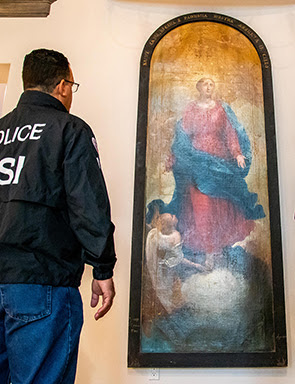
HSI Dallas was able to locate the painting after receiving a tip from the HSI Attaché Office in Rome.

DALLAS, TX.- U.S. Immigration and Customs Enforcement’s (ICE) Homeland Security Investigations (HSI) in Dallas, Texas, recovered a 19th century painting Wednesday that was stolen from the Abbey of Santa Maria in Sylvis in Sesto al Reghena, Italy, in May 2002. The painting called “the Assumption of the Virgin Mary” was created by Italian artist Giuseppe Pappini in August 1851.

HSI Dallas was able to locate the painting after receiving a tip from the HSI Attaché Office in Rome, Italy, in 2019. Based on that tip, HSI tracked the painting to a private art collector in the Dallas-area who had purchased the painting in 2015 from a dealer who was unaware that it was stolen. After learning of the painting’s origins, the private collector voluntarily agreed to hand it over to HSI so that it could be repatriated to Italy and returned to the monastery.

“Investigating the loss or looting of cultural heritage properties and returning them to their countries of origin is an important part of HSI's diverse mission” said Ryan L. Spradlin, special agent in charge of HSI Dallas. “Our specially trained investigators and attachés in more than 40 countries not only partner with governments, agencies and experts who share our mission to protect these items, but they train the investigators of other nations and agencies on how to find, authenticate and enforce the law to recover these items when they emerge in the marketplace.”

This is an HSI Dallas-led investigation with assistance from the HSI Attaché Office in Rome, Italy, and HSI Headquarters Cultural Property, Arts, and Antiquities (CPAA) Division in Washington, D.C.

https://artdaily.cc/news/128019/ICE-recovers-19th-century-painting-stolen-from-Italian-monastery#.X6lTS2hKjIU

Wednesday, September 16, 2020

No laughing matter as Dutch masterwork stolen for third time!

This photograph taken on November 3, 2011, shows District Chief of Alblasserwaard, Bart Willemsen showing the recovered painting "Two Laughing Boys" by Frans Hals which was stolen from the Leerdam Museum in May 2011. Thieves have stolen the painting "Two Laughing Boys" by Dutch golden age artist Frans Hals from a museum in the Netherlands, the third time it has been taken, police said on August 27, 2020. Ilvy Njiokiktjien / ANP / AFP.

THE HAGUE (AFP).- Thieves have stolen the painting "Two Laughing Boys" by Dutch golden age artist Frans Hals from a museum in the Netherlands, the third time it has been taken, police said Thursday.

The canvas by the 17th century master was taken during a burglary at the Hofje van Mevrouw van Aerden museum in Leerdam in the early hours of Wednesday, they said.

The painting, featuring two laughing boys with a mug of beer, was previously stolen from the same museum in 2011 and 1988, being recovered after six months and three years respectively.

Dutch police said in a statement that officers rushed to the museum in the town 40 miles (60 kilometres) south of Amsterdam after the alarm went off around 3:30 am but they failed to find the suspects. "After the manager of the museum was able to provide access to the building, it turned out that the back door had been forced and one painting had been stolen, 'Two Laughing Boys'," the statement said.

Police said they had started an "extensive investigation" involving forensic investigators and art theft experts. They were checking cameras and talking to witnesses and local residents, they added.

Frans Hals was a contemporary of fellow masters Rembrandt and Vermeer during the Dutch Golden Age, a flowering of trade, colonialism and art in the Netherlands roughly spanning the 17th century. He is best known for works including "The Laughing Cavalier", which hangs in the Wallace Collection in London, and "The Gypsy Girl", now housed in the Louvre in Paris.

Dutch art detective Arthur Brand -- dubbed the "Indiana Jones of the art world" after tracking down a series of stolen works -- tweeted that "the hunt is on" for the "very important and precious painting by Frans Hals." Brand said the "Two Laughing Boys", an officially designated piece of Dutch national heritage, had been stolen on the anniversary of Hals' death in 1666.

In March burglars stole the Vincent van Gogh painting "Parsonage Garden at Nuenen in Spring" from another Dutch museum that was closed for coronavirus measures, on what would have been the painter's 167th birthday.

Brand said n June that he had received two recent photos of the van Gogh as "proof of life".

© Agence France-Presse

https://artdaily.cc/news/127751/No-laughing-matter-as-Dutch-masterwork-stolen-for-third-time

Tuesday, August 4, 2020

A refugee from Rwanda, confessed to starting the fire and been charged with arson, official sources say. Stating he was angered because his visa had not been renewed.

A volunteer who cleaned and locked Nantes cathedral on the evening of 17 July has confessed to starting the fire and been charged with arson, official sources say. The man, a refugee from Rwanda, was angered because his visa had not been renewed. Following a series of attacks on cultural and religious sites, the law was changed in 2008 so now those charged with criminal damage to historical buildings in France face a maximum of seven years in prison. 


A blaze broke out inside the gothic cathedral of Nantes on 18 July © Sebastien Salom-Gomis/AFP via Getty Images 

 Only one year after a devastating fire engulfed Notre Dame cathedral in Paris, the fire that broke out in the Gothic St Peter and St Paul Cathedral, in Nantes, western France, on Saturday morning has raised alarm bells about the security of France’s 150 cathedrals and 45,000 churches. France's new prime minister Jean Castex rushed to the scene with the home and religious affairs minister Gérald Darmanin and culture minister Roselyne Bachelot, while images of the church's interior darkened by smoke appeared on television news. 

 It took two hours for a hundred firefighters to contain the fire, which destroyed the baroque 1627 grand organ and a smaller 19th-century choir organ, as well as sculptures and a 19th-painting sent by Jean-Hippolyte Flandrin from the French Academy in Rome. An arson investigation was opened after firemen spotted three fire starting points. But today, a source close to the investigation said the fire may have started in an old electrical cabinet beneath the grand organ (a device that is no longer authorised in public places) and may have spread to the other organs via electrical circuits. 

 A Rwandan refugee, a volunteer who cleaned the church before it was locked down for the night, was interviewed but released on Sunday without charge. No trace of a break-in has been found. Critics have underscored the the lack of care and funding from the state as well as the cities in which religious buildings are located. 

Nantes cathedral was destroyed by fire in 1972 and was rebuilt over more than a decade. Another 19th-century church had its roof destroyed in the city in 2015. And, in the capital, Saint Sulpice church, which is the temporary cathedral of Paris now, was also damaged by a fire last year. “There is no country in Europe where fires are so common in churches,“ says the architecture historian Alexandre Gady, who also says that “there is no capital on the continent where churches are so damaged”. 

After Notre Dame’s fire, the catholic church asked for a comprehensive survey of the safety of these historical buildings, Gady says, "Has it been done? And if so, where is it?” 

VINCENT NOCE 20th July 2020 12:26 BST 

Saturday, June 20, 2020

Images of a stolen Van Gogh give experts hope it can be recovered

In an undated handout image, the stolen work, Van Gogh’s “The Parsonage Garden at Nuenen in Spring,” is shown between a copy of The New York Times, which featured an article on the theft, and a copy of a biography of a man who had previously stolen van Goghs. A private art detective investigating the case said he was sent the images of the work, which was taken from a Dutch museum in March. Handout via The New York Times.

AMSTERDAM (NYT NEWS SERVICE).- The photographs look like the sort of images that kidnappers distribute with a ransom demand to establish that their victim is alive. A newspaper’s front page is included and used as a time stamp to indicate that the images are recent.

In this case, the subject isn’t a kidnapping victim, but rather a Vincent van Gogh painting that was stolen from the Singer Laren Museum in the Netherlands in March. Arthur Brand, a private Dutch art crimes detective who is investigating the theft, said only that he received them from a “source in my network,” without further elaboration.

He posted them on his Twitter feed and shared them with a Dutch newspaper, De Telegraaf. Brand suspects that the images were circulated in criminal circles in an effort to find a potential buyer.

“They are important because it’s a proof of life,” Brand said. “In many cases like this art theft, you see that criminals get nervous and they feel the police are on their backs and they destroy it. Now we know that it hasn’t been destroyed.”

The police investigating the case did not immediately respond to a request for comment. Brand declined to say whether he had been contacted by the police about the photos.

Ursula Weitzel, a leading art crimes prosecutor in the Netherlands, said she had never seen “proof of life” photographs of art works circulated like this. The painting, “The Parsonage Garden at Nuenen in Spring,” from 1884, was stolen while part of a temporary exhibition at the Singer Laren, on loan from the Groninger Museum.

Security camera footage of the robbery on March 30 shows a man breaking into the museum using a sledgehammer to smash two glass doors and leaving with the painting under his arm.

Andreas Blühm, director of the Groninger Museum, said the photographs of the painting appear authentic, because one shows the back of the work. “You can only have that if you have the painting,” he said in an interview.

He said that he could not comment on whether the museum had been approached with a ransom demand.

Monday, June 15, 2020

Missing Banksy artwork found in an abandoned farmhouse in Abruzzo, Italy

Stolen Banksy work from door of Paris Bataclan found in Italy 
The work was found in an abandoned farmhouse in Abruzzo, according to l'Aquila prosecutor Michele Renzo, who said further details would be provided on Thursday. by Ella Ide 

ROME (AFP).- Italian police said Wednesday they had retrieved a work by famed street artist Banksy commemorating the victims of the November 2015 Paris terror attacks stolen from the Bataclan concert hall. 

The work was an image of a girl in mourning painted on one of the emergency doors of the Parisian venue, where Islamic State gunmen massacred 90 people. It had been cut out and taken in 2019. 

"We have recovered the door stolen in the Bataclan with a Banksy work portraying a sad young girl," a senior Italian police officer from Teramo, in Italy's central east Abruzzo region, told AFP. 

The raid was conducted with French police, he added. The work was found in an abandoned farmhouse in Abruzzo, according to l'Aquila prosecutor Michele Renzo, who said further details would be provided on Thursday. 

Works by Banksy, known for their distinctive style, irreverent humour and thought-provoking themes, have been found on walls, buildings and bridges from the West Bank to post-Hurricane Katrina New Orleans. At auction, they have sold for more than $1 million. 

Stealing works: The portion of the Bataclan door is not the only Banksy to have been stolen from Paris. In 2018, the artist "blitzed" the French capital with murals during a whirlwind trip, which he said was to mark the 50th anniversary of the Paris student uprising of 1968. After he appeared to authenticate eight of the Paris works on his Instagram account, it did not take long for thieves to strike. 

Works stolen included a mural of a businessman in a suit offering a dog a bone, having just sawed the animal's leg off. Another was an image of a masked rat wielding a box cutter, which disappeared from outside the Pompidou Centre. 

Banksy took on the rat as his avatar, a symbol of the vilified and downtrodden, in homage to Paris street artist Blek le Rat. Blek started out in 1968 when a general strike by students and workers brought France to a halt. 

Some of the stolen works have since been recovered and fans have covered some of his Paris street art with Plexiglass to protect them. But one mural of a migrant girl was defaced with blue spray paint shortly after news of its discovery spread on social media. 

Banksy is believed to have started out as a graffiti artist in London, although he has kept his identity a secret. The most dramatic of his Paris 2018 creations was a pastiche of Jacques-Louis David's "Napoleon Crossing the Alps", with Bonaparte wrapped in a red niqab. It appeared on a wall in an ethnically mixed district of northern Paris. 

 © Agence France-Presse